
When it comes to your eyesight, timing is everything. That’s especially true with keratoconus, a progressive eye condition that affects the cornea — the clear front surface of the eye. If spotted early, treatment can slow or even halt its progression, helping to preserve vision for years to come.
But here’s the challenge: in its early stages, keratoconus can be subtle and often mistaken for something else, like ordinary astigmatism. Many patients only seek help once their vision has already deteriorated.
So how can you spot the warning signs before keratoconus progresses? Let’s explore what to look out for, why it happens, and when to seek help.
What Exactly Is Keratoconus?
Keratoconus is a condition where the cornea becomes thinner and starts to bulge outward into a cone-like shape. Instead of being smooth and round, the cornea becomes irregular, scattering light and causing distorted vision.
It usually begins in the teenage years or early twenties, though it can appear later. The progression varies — some people experience only mild changes over decades, while for others the condition advances much more quickly.
Early Signs of Keratoconus
In the beginning, keratoconus can be tricky to spot because the symptoms mimic other, more common vision issues. However, there are a few red flags that should prompt further investigation:
- Frequent prescription changes: If your glasses or contact lens prescription keeps changing more often than usual, it could be more than “just ageing eyes.”
- Distorted or blurred vision: Straight lines may start to look wavy, or objects may appear stretched or ghosted.
- Increased sensitivity to light: Bright sunlight or headlights at night may feel uncomfortable or cause glare.
- Halos and starbursts: Around lights, especially at night, you may notice halos or star-like flares.
- Difficulty with night driving: Many patients say night driving was one of the first activities where they noticed a problem.
If you’re ticking more than one of these boxes, it’s worth asking your optometrist or ophthalmologist for a corneal scan.
Why Early Detection Is So Important
The earlier keratoconus is diagnosed, the more options we have to stop it progressing. The gold-standard treatment is corneal cross-linking (CXL), a procedure that strengthens the cornea by using UV light and vitamin B2 drops.
CXL doesn’t reverse keratoconus, but it can stop it in its tracks. Once the cornea is stabilised, patients may then benefit from further treatments — such as topography-guided laser, special contact lenses, or even advanced techniques like the Xenia implant — to improve clarity of vision.
If keratoconus isn’t detected early, the cornea can become too thin or scarred for these treatments, leaving corneal transplant surgery as the only option.
How Keratoconus Progresses
Keratoconus progression isn’t always predictable, but in general:
- Mild keratoconus: The cornea is only slightly irregular. Glasses or soft contact lenses may still work.
- Moderate keratoconus: Vision distortion increases. Rigid gas permeable or scleral lenses may be needed.
- Advanced keratoconus: The cornea becomes steep, thin, or scarred. Glasses and normal contacts often don’t help, and surgery may be required.
Because it’s progressive, waiting too long can mean missing the window for simpler, less invasive treatments.
Risk Factors That Speed Up Progression
While keratoconus can affect anyone, certain factors increase the risk of faster progression:
- Age: Younger patients tend to progress more quickly.
- Family history: Genetics plays a role; if keratoconus runs in your family, you’re at higher risk.
- Eye rubbing: This is a big one. Chronic rubbing weakens the cornea and accelerates progression.
- Allergies or dry eye: Conditions that make you rub your eyes more can worsen keratoconus.
Being aware of these factors helps patients (and doctors) keep a closer watch on changes.
When to See a Specialist
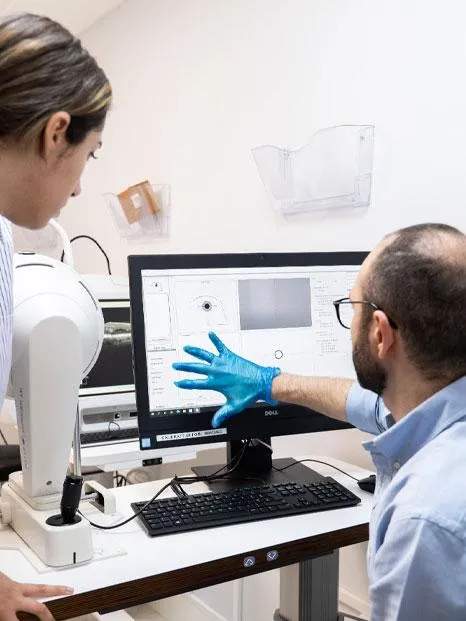
If you suspect you may have keratoconus — or if you’ve been told you have astigmatism that keeps getting worse — it’s worth seeing a specialist. At The Harley Street Eye Centre, we use advanced corneal imaging to detect even the earliest signs of keratoconus.
Even if you’re not sure, getting checked can provide peace of mind. And if it turns out you do have keratoconus, catching it early can make all the difference to your long-term vision.
Want to read more about Keratoconus Treatments? Click here
Living With Early Keratoconus
For patients diagnosed early, the outlook today is much brighter than it was just a decade ago. With treatments like corneal cross-linking and customised lenses, many people maintain excellent quality of life.
Simple lifestyle changes can also help slow progression:
- Avoid rubbing your eyes — use lubricating drops if they feel itchy or irritated.
- Protect your eyes from UV light with sunglasses.
- Manage allergies proactively to reduce discomfort.
Combining these habits with regular check-ups and modern treatments means keratoconus doesn’t have to hold you back.
Don’t Wait for It to Worsen
Keratoconus is a condition where early detection is everything. The warning signs — frequent prescription changes, distorted vision, increased sensitivity to light — are easy to dismiss as “just needing new glasses.” But if left unchecked, keratoconus can progress to the point where vision correction becomes far more complex.
The good news? With today’s technology, from cross-linking to advanced implants, we have the tools to protect and restore vision for keratoconus patients like never before.
So if you’ve noticed your glasses aren’t doing the job anymore, or if your optician has raised concerns about astigmatism, don’t wait. Book a specialist consultation. The earlier we spot keratoconus, the brighter your visual future will be.