
Advancing the Science of Vision Through Innovation
Translating Ophthalmic Research Into Clinical Impact
Innovation is the foundation of progress in modern eye care. Our research activity spans the spectrum from concept design and laboratory testing to clinical validation and international regulatory submission, ensuring that new technologies move safely and effectively into patient care.
Since 2013, our focus has been on corneal biomechanics, implantable device development, and neuro-ophthalmic stimulation therapies. Every project is guided by three principles: scientific rigour, clinical relevance, and long-term benefit for patients.
MAG Optics – Innovating Intra-Corneal Implants
Founded in 2013, MAG Optics was established to develop new intra-corneal implants for the management of keratoconus and other corneal ectatic disorders. The concept combined optical correction with structural reinforcement to stabilise and regularise the cornea.
The success of the company’s early prototypes led to its acceptance into the Johnson & Johnson J Labs accelerator in the USA, where further work refined implant geometry, material biocompatibility, and surgical delivery systems.
This project represents a benchmark in translational ophthalmic innovation—transforming engineering concepts into clinically deployable solutions.
United Scientific Associates – Clinical Research & Regulatory Expertise
To complement device innovation, United Scientific Associates was created as a specialist clinical research organisation supporting ophthalmic implant manufacturers and innovators preparing for international clinical and regulatory approval.
The team provides:
- Clinical trial protocol design and feasibility assessment
- Statistical planning, data management, and safety analysis
- Clinical evaluation reports and documentation for CE Mark, FDA, and UKCA submissions
- Regulatory pathway and post-market study strategy
This capability enables early-stage innovations to meet the high standards required for global market entry.
Collaborative Research with Okuvision (Germany)
In partnership with Okuvision GmbH, ongoing research focuses on trans-corneal electrical stimulation (tCES) as a potential therapy for retinitis pigmentosa and related retinal degenerations.
This work includes developing clinical delivery pathways, treatment frequency models, and safety and efficacy endpoints for the integration of tCES into standard ophthalmic practice. Early clinical data have demonstrated encouraging improvements in retinal responsiveness and patient-reported visual stability.
Lens Innovation – The Mix-and-Match Approach
Our research in refractive and cataract surgery pioneered the “mix-and-match” intra-ocular lens (IOL) strategy, combining monofocal, extended-depth-of-focus (EDOF), and multifocal lens technologies.
By customising IOL combinations to each eye, this method achieves:
- Spectacle independence for all visual ranges
- Reduced glare and halo phenomena
- Improved contrast sensitivity and night vision
This evidence-based approach has influenced modern refractive practice worldwide and remains central to advanced lens-surgery planning.
Clinical Research Team
Our research and innovation programmes are guided by an experienced, multidisciplinary team combining surgical expertise, translational science, and biomedical research leadership.
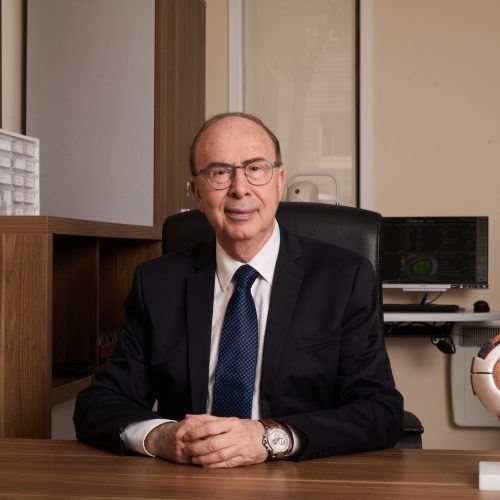
Mr Marwan Ghabra
Consultant Ophthalmic Surgeon | Founder, MAG Optics & United Scientific Associates
Specialist in corneal and refractive surgery with extensive experience in intra-corneal implant design, keratoconus management, and lens-based refractive surgery. Developer of the Ghabra Technique for collagen lenticule implantation and early pioneer of the mix-and-match IOL strategy.
Dr Hakam Ghabra
Ophthalmic Physician & Clinical Research Director
Leads on clinical study design and translational research for emerging ocular therapies, including trans-corneal electrical stimulation (tCES). Experienced in integrating scientific development with patient-centred clinical delivery.
Together, this team brings complementary strengths across surgery, translational science, and regulatory expertise—ensuring each innovation is clinically relevant, evidence-driven, and ethically conducted.


Professor John Marshall
Honourary Innovation Advisor, Professor Emeritus of Ophthalmology, King’s College London
Internationally recognised for his contributions to laser refractive surgery, photochemical corneal cross-linking, and translational ophthalmic research. Professor Marshall provides scientific oversight and mentorship across multiple innovation streams.
Areas of Research Focus
Corneal Biomechanics & Implant Design
Development of bio-integrated collagen and polymer implants for keratoconus and post-LASIK ectasia.
Retinal Neuro-Stimulation
Clinical modelling of trans-corneal electrical stimulation to preserve visual function in degenerative retinal diseases
Refractive Lens Optimisation
Patient-specific IOL selection algorithms combining optical physics and neuro-visual adaptation.
Clinical Research Infrastructure & Regulatory Science
Designing ophthalmic trials, regulatory documentation, and device-approval strategies that bridge engineering and clinical medicine.